Українська · Русский · English
Evidence for God’s Existence — Not Only in the Bible
Author's Preface
In this article, I want to examine evidence for God's existence—something truly obvious and convincing that does not require appealing to authoritative sources such as the Bible or invoking the authority of those who follow Holy Scripture.
I would like to find arguments that would allow a person capable of logical reasoning to say with confidence: “Yes, God exists” or “No, God does not exist.” To do so, it should be enough to observe the world around us, have some education, understand natural processes, possess basic knowledge of physics, mathematics, and other natural sciences, and, ultimately, simply use common sense.
I will be honest: I spent a long time gathering my thoughts before beginning this article, because there really is a great deal of material. I have probably spent entire days, perhaps even weeks, discussing these questions with atheists, agnostics, and believers, trying to understand which issues cause the most confusion, where skepticism about God's existence comes from, and why doubts arise even among believers.
So, in undertaking this article, I really want to bring together everything I know, everything I have managed to explore and reflect upon over a long period, without leaving out anything important.
I therefore apologize in advance: what began as a short article has turned into a treatise of more than fifty pages.
God spent more than ten billion years creating this world, and this is only a brief article compared with everything He has done for us.
And perhaps writing it is the least I can do to express my gratitude to Him.
But did God really create this world? Or did the Universe arise on its own, without any Creator?
That is precisely what we will try to establish through logic, scientific knowledge, and our own observations, without requiring the reader to hold any prior religious beliefs.
Introduction
Before examining the evidence for God's existence in detail, I want to briefly outline the main questions we will explore in this article.
I am not asking you to accept these claims on faith. On the contrary, we will examine each separately, investigate scientific and historical support, and consider possible objections.
-
Human Consciousness—the crisis in the scientific approach to explaining consciousness as evidence of the existence of the immaterial, the supernatural, and the mystical.
-
The Fine-Tuning of the Universe—an argument for intelligent design that is seriously discussed in scientific and philosophical circles.
-
The Axioms of Geometry—geometry as an example of how every exact science rests on faith.
-
The Second Law of Thermodynamics, Entropy, and Boltzmann's Formula—the paradox of evolution: when the improbable becomes possible.
1. Human Consciousness
Cogito, ergo sum.
“I think, therefore I am.”
I will begin presenting the evidence with something simple that requires no specialized knowledge whatsoever, only observation and attention to something possessed by every one of us who calls themselves human.
This chapter is devoted to human consciousness and the crisis in the scientific approach to studying it.

The Problem of Defining Consciousness
If we ask a simple scientific question—“What is consciousness?”—and try to examine it carefully, we discover that the crisis in the scientific approach to studying consciousness begins before the investigation itself.
We cannot even provide a comprehensive definition of what we intend to study.
You can open Wikipedia in Ukrainian, Russian, or English and find a collection of words that seem to form meaningful sentences, yet still fail to convey the essence of the question.
But perhaps it would be more honest to put this question to you personally first, rather than send you straight to Wikipedia. Try spending at least one day thinking about what consciousness means to you and how you would explain its essence to another person. Then return to my article once you have developed a reasonably clear understanding of this question. I hope the rest of the text will then be easier to understand.
But let us return to the substance of the question.
For example, the Ukrainian Wikipedia article on consciousness contains the following statement:
“Despite the lack of an unambiguous definition, most people intuitively understand the essence of this phenomenon, although each in their own way.” Wikipedia—Consciousness [3]
Something similar appears in the English Wikipedia:
“There is no consensus on what exactly needs to be studied, or whether consciousness can be considered a scientific concept.” Wikipedia—Consciousness [4]
In other words, there is no agreement about what exactly needs to be studied or whether consciousness can even be considered a scientific concept.
Let us nevertheless examine the attempts to define consciousness. If you look for definitions in various sources, you will most likely encounter one of two approaches.
-
Defining consciousness by listing its properties
Most often, you will find a list of properties that supposedly characterize consciousness, but that may actually also belong to objects whose consciousness we have no grounds to affirm.
For example, modern artificial intelligence can demonstrate remarkable intellectual abilities, solve complex mathematical problems, analyze information, and draw logical conclusions.
Artificial intelligence can be equipped with sensors through which it perceives the surrounding world. It can also be trained to recognize emotions, respond to them, and even simulate emotional experiences of its own.
How exactly do our emotions differ from their simulation by artificial intelligence?
But does this mean that artificial intelligence is conscious?
We know that modern artificial intelligence operates by performing mathematical operations.
The central problem can be stated as follows: if a definition of consciousness allows us to attribute it to any object solely on the basis of certain properties, including objects that do not possess consciousness, then that definition does not reveal the essence of consciousness itself.
-
Defining consciousness through other concepts that themselves require explanation
Other definitions you may encounter attempt to explain consciousness through concepts such as
qualiaorawareness, an English word often used as a synonym for consciousness.However, these concepts themselves require definition.
Qualia, for example, are the subjective qualities of our experience: how we personally experience pain, taste something, perceive colors, or hear music.
But what exactly does “subjective experience” mean?
Here, we risk going around in circles: to explain consciousness, we invoke qualia; to explain qualia, we invoke subjective experience, which in turn brings us back to consciousness.
The main conclusion I can reach so far is that the concept of consciousness is closely connected to the very question of what it means to be human.
I also want to focus separately on the English word
awareness. It seems thatawarenessand our subjective experience bring us closest to understanding the elusive quality we call consciousness. However, if we examine the practical use of this word more closely, we find that it often means something quite different.For example,
awarenessmay refer to knowledge of particular circumstances, recognition of moral and ethical responsibility, or the ability to notice situations that require us to take action.Yet artificial intelligence can be taught all of these things as well.
We need only give it a set of ethical rules and train it to recognize relevant situations and respond appropriately.
Thus, we can create a system that demonstrates
awarenessin the practical sense of the word, but the presence of this property alone would not establish that the system possesses consciousness.
The Properties of Scientific Terms
I want to compare consciousness with other scientific concepts.
Consider, for example, time, physical force measured in newtons, or energy measured in joules. These concepts are much clearer: we can define them precisely, measure the corresponding physical quantities, describe their role in natural processes, and establish mathematical relationships governing their interactions.
We can also explain what will happen to a physical system if a particular quantity changes or a corresponding physical interaction is absent. In other words, we understand not only how to describe these phenomena, but also the role they play in physical processes and how they affect the surrounding world.
But can we say the same about consciousness?
The Problem of the Functions of Consciousness
When I failed to find a sufficiently convincing definition of consciousness, I decided to approach the question from another direction: to try to understand what function it performs and what would happen to us if we lacked consciousness.
This is one of the questions whose consideration eventually brought me back to faith in God. But this chapter is not about theology, so let us approach the question scientifically.
We know the roles of the various organs of the human body. The heart circulates blood, the lungs exchange gases, the eyes perceive light, and the brain processes information received from the senses.
Modern artificial intelligence demonstrates the ability to process information, learn, and make decisions using mathematical models. Artificial neural networks were developed by analogy with the operating principles of biological neurons, although their mathematical models are greatly simplified.
In philosophy, there is the concept of a philosophical zombie (or p-zombie): a hypothetical being physically and behaviorally indistinguishable from an ordinary human, yet lacking subjective experience.
And here a difficult question arises: if we consider evolution from a purely materialist perspective, it would seem that it could have produced a being like a philosophical zombie (p-zombie), performing all human functions without the need for subjective experience, much as artificial intelligence today can already perform many intellectual functions without any demonstrated consciousness. Why, then, do we have consciousness?
Let me make this a little more concrete.
For example, when we touch a hot object, the nervous system can trigger a reflex that withdraws our hand before we become conscious of the pain.
We also know that a substantial portion of information processing in the human brain takes place without our conscious control.
Thus, even within our own bodies, complex mechanisms operate without the direct involvement of consciousness.
But what function does consciousness itself perform?
If many physiological and intellectual processes can occur without awareness, why do we need subjective experience?
And if consciousness does perform a particular function, how can we experimentally distinguish that function from brain activity?
The Problem of Proof and Measurement
Consciousness may be one of the first phenomena humans came to know through personal experience. But something distinguishes it from familiar physical quantities: we can measure those quantities, whereas there is still no generally accepted way to directly measure consciousness and verify the presence of subjective experience.
Suppose, for example, that we have two physical bodies before us. We can establish, to a certain degree of precision, that one has a mass of 10 kg and the other 15 kg.
But when we speak of a person, in what units can we measure the amount of their consciousness?
Perhaps we could choose one person as a reference and conventionally assign them one unit of consciousness. But how would we then determine how many such units another person has? Half a unit? One and a half? And on what basis could we establish this?
To be honest, this approach even seems somewhat immoral to me.
But the problem runs far deeper than the absence of units of measurement.
Not only are we unable to measure consciousness as an ordinary physical quantity—we do not even have a generally accepted way to directly prove or disprove the presence of subjective experience in another being.
Each of us is directly aware of our own subjective experience, but we do not have the same access to another person's inner experience. This is precisely what makes consciousness so difficult to study scientifically.
Imagine a philosophical zombie (p-zombie) standing beside us. Under the conditions of this thought experiment, we would have no way to distinguish it from an ordinary person.
Here, I would like to draw an important conclusion directly relevant to the central subject of this article: evidence for God's existence.
There are phenomena that we cannot directly measure or whose presence we cannot independently confirm or refute, yet whose existence remains obvious to us through personal experience. Consciousness is one such example.
In discussions about God's existence, we often hear the argument that His existence has not been scientifically proven and that there is therefore no reason to consider Him real.
But we also have no way to directly prove the presence of subjective experience in another person. This certainly does not mean that consciousness does not exist.
The absence of scientific proof that something exists is not, in itself, proof that it does not exist.
Therefore, when investigating God's existence, we must apply the same principles of scientific inquiry that we apply to consciousness: assess evidence honestly, consider arguments impartially, and acknowledge the limits of our knowledge.
Conclusions from Our Examination of Human Consciousness
Let us summarize the conclusions we have reached in examining human consciousness.
- The problem of definition. We still lack a generally accepted, comprehensive definition of consciousness that reveals its essence. Attempts to define consciousness through lists of properties or other concepts do not provide a definitive answer to what consciousness is.
- The problem of functions. We know the functions of the various organs of the human body and can explain many processes of information processing in the brain. However, the question remains open as to what function subjective experience performs and why physical processes are accompanied by conscious experiences at all.
- The problem of measurement. Unlike familiar physical quantities such as mass, force, or energy, consciousness has no generally accepted unit of measurement. We cannot directly measure the amount of subjective experience or establish its presence in the same way we measure physical quantities.
- The problem of proof. Each of us directly experiences our own consciousness, but we have no generally accepted way to independently prove or disprove the presence of subjective experience in another being. We could not even identify a hypothetical philosophical zombie, physically and behaviorally indistinguishable from a human, by external characteristics.
The Mystical Nature of Consciousness
The fact that science cannot yet fully explain a phenomenon does not mean that it has a mystical nature, much less prove the existence of the supernatural.
But now I want to address you as one human being to another.
I cannot explain in words what consciousness is. All our preceding conclusions point to one thing: neither science, nor logic, nor philosophy has yet provided a comprehensive answer to this question.
But there is something I can suggest.
Please look away from the screen. Get up from your chair, go to the bathroom, stand before a mirror, and look carefully at yourself.
I am entirely serious. Do not simply read these words and continue with the article. Actually go to the mirror.
Look into your own eyes.
Who do you see there?
A philosophical zombie? A complex biological machine? Or a person aware of their own existence?
Most importantly, what does it mean to you personally not merely to see your reflection, but to be aware that you are the one seeing it?
Have you done it?
I can see that you have not. I am telling you—do it!
All right, let us assume you actually did what I asked.
Now I will give you a simple answer to the question of what you saw in the mirror.
What you feel within yourself is your consciousness. It gives you the sense of your own existence, the awareness that you are alive, that you are a real human being rather than merely a complex biological machine or robot.
And this subjective experience of your own existence—your consciousness—is evidence of something immaterial, supernatural, something we call mystical, existing in our entirely real world.
For there is simply no way to call this phenomenon material.
Does God Exist?
The mere existence of consciousness, even if we acknowledge its immaterial, supernatural, or mystical nature, does not yet mean that God exists.
However, this realization is profoundly important because it broadens the boundaries of our understanding of reality itself.
If we are convinced that everything real must have a material nature and be subject to scientific investigation, we are restricting our understanding of the world to materialism from the outset.
But if we acknowledge consciousness as a manifestation of something immaterial or even supernatural, an entirely different picture of the world opens before us.
We begin to realize that reality may be considerably broader than the material world we can observe, measure, and describe through the laws of physics.
In my view, this is the most important conclusion of our examination of consciousness.
Moreover, the very existence of our consciousness proves the existence of that part of reality which extends beyond the material world. And we already know with certainty at least one of its manifestations: our own consciousness.
Thus, the mystical is no longer merely an abstract possibility for us. It exists and is part of our reality.
And if such a reality exists, we have no grounds for assuming that consciousness is its only manifestation. It may also contain other phenomena and forces, still unknown to us, which people associate with ideas of God or gods.
2. The Fine-Tuning of the Universe
Werner Heisenberg
„Der erste Schluck aus dem Becher der Naturwissenschaft macht atheistisch, aber auf dem Grund des Bechers wartet Gott.“
“The first sip from the cup of natural science makes one an atheist, but at the bottom of the cup, God awaits.”
— Attributed to Werner Heisenberg.
A similar statement is quoted by Carl Friedrich von Weizsäcker, Heisenberg's student and colleague, in his book Die Geschichte der Natur (1948) [5].
In the previous chapter, we examined human consciousness—a phenomenon whose existence each of us can confirm through personal experience, but whose nature remains a mystery. We also considered the problem that the scientific approach cannot even begin to investigate this phenomenon.
Now I want to consider God's existence from another angle. This time, we will not turn to personal subjective experience, but will try to examine the question from a more objective perspective, drawing on the fundamental laws of physics and modern scientific ideas about the Universe.
To do so, let us turn to two concepts: the fine-tuning of the Universe and the anthropic principle.
I place the fine-tuning argument second among the arguments for God's existence not because I personally find it the most convincing, but because this question is indeed taken seriously in scientific and philosophical circles.
If you asked which argument I would personally place second, I would probably choose the second law of thermodynamics and Boltzmann's formula. But we will discuss those in a later chapter.
From the perspective of the Bible, the anthropic principle seems a weaker argument to me, since it does not in itself imply the existence of God as a distinct person with His own will and power.
The Anthropic Principle and Consciousness
If we refrain from turning to the Bible, as I promised at the very beginning, the anthropic principle leaves another profoundly important question unanswered: the question of human consciousness.
If we consider the observer referred to in the anthropic principle from a purely materialist perspective, even the philosophical zombie discussed in the previous chapter could fulfill that role.
Such a being could receive information, analyze it, and respond to the surrounding world without any subjective experience.
But we know that at least one observer—each of us—possesses consciousness. And the anthropic principle itself does not explain why this is so.
The Anthropic Principle and the Bible
However, I see an interesting avenue for reflection here.
If we consider the anthropic principle more broadly—not merely as a condition for the existence of observers, but also as a starting point for thinking about the emergence and development of intelligence—we can ask: could the development of human intelligence and society have led to the emergence of the Bible and the teachings of Jesus Christ precisely because moral principles are necessary for humanity's survival?
After all, an intelligence capable of creating complex technologies is also capable of creating the means of its own destruction.
And unless humanity learns to use its abilities responsibly, it risks destroying itself.
Thus, we may suppose that the anthropic principle, in its broader philosophical sense, could explain not only humanity's emergence, but also the appearance of the Bible and the teachings of Jesus Christ as necessary conditions for its salvation. In other words, the very process that led to humanity's emergence could have been directed toward ensuring that humanity would not merely appear, but would also receive the opportunity to save itself from self-destruction.
Within this philosophical understanding, we might even ask whether intelligence plays the role of the creative force traditionally associated with God.
Of course, this is not a generally accepted formulation of the anthropic principle. Moreover, this understanding of God contradicts traditional Christian teaching about God as a distinct Creator-person and may be considered heretical from the standpoint of orthodox Christianity.
However, my task in this part of the article is to examine arguments for God's existence without relying on the authority of the Bible.
I therefore consider it necessary to examine this possibility as well, even if it does not accord with traditional Christian theology.
Nevertheless, regardless of whether God exists as a distinct Creator-person or whether we consider intelligence a force determining the world's further development, I am convinced that the Bible and the moral teachings of Jesus Christ deserve special respect and attention.
The Anthropic Principle as an Answer to Scientific Atheists and Agnostics
Many atheists claim that science has found no evidence whatsoever for God's existence.
I consider such categorical reasoning a manifestation of ignorance—or dishonesty if someone deliberately suppresses facts known to them.
Scientific research into the fine-tuning of the Universe does exist. It shows how important the fundamental properties of our world are for the emergence of complex matter and life.
Although this research does not itself prove God's existence, it provides grounds for seriously considering intelligent design.
In my view, the fine-tuning of the Universe and the role of intelligence in its further development are arguments for the idea that mind may have a much more fundamental significance for our reality than we are accustomed to assuming.
Now I suggest we turn directly to scientific research.
Scientific Authorities and Research into the Fine-Tuning of the Universe
Before discussing specific physical phenomena, I would like to draw your attention to scientists who have investigated the fine-tuning of the Universe.
This is not merely a matter of philosophical reflection or religious belief.
The fine-tuning of the Universe and anthropic constraints on physical parameters have been studied by distinguished physicists and cosmologists, including Nobel Prize laureates.
Steven Weinberg
Steven Weinberg was an American theoretical physicist who received the Nobel Prize in Physics in 1979 for his contribution to the theory unifying the weak and electromagnetic interactions.
In 1987, he published a paper in Physical Review Letters:
Anthropic Bound on the Cosmological Constant [7].
In this study, Weinberg considered how the value of the cosmological constant is constrained by the conditions required for the formation of gravitationally bound structures in the Universe.
If the positive cosmological constant were sufficiently large, the expansion of the Universe would prevent such structures from forming.
This means that the value of a fundamental cosmological parameter is directly connected to the possibility of galaxies forming, and therefore to the familiar conditions necessary for life to emerge. DOI [7]
It should be emphasized that Weinberg received his Nobel Prize for other research. Nevertheless, his paper on anthropic constraints on the cosmological constant is an independent scientific contribution to this question.
Interestingly, Weinberg himself did not favor a religious explanation of the Universe.
Thus, we have an example of a scientist who investigated anthropic constraints on fundamental physical parameters independently of religious beliefs.
Martin Rees
Martin Rees is a British astrophysicist who served as president of the Royal Society of London.
In 1999, he published the book:
Just Six Numbers: The Deep Forces That Shape the Universe [8].
In it, Rees examines six fundamental parameters that determine the structure and evolution of our Universe.
He explains how changing these parameters would affect the possibility of galaxies, stars, chemical elements, and complex structures forming. Google Books [8]
This is another example of the serious scientific interest in the fine-tuning of the Universe.
Luke Barnes
Another researcher is the astrophysicist Luke Barnes.
In 2012, he published the scientific paper:
The Fine-Tuning of the Universe for Intelligent Life [9].
It appeared in the peer-reviewed journal Publications of the Astronomical Society of Australia.
Barnes systematically examines physical parameters that affect the possibility of complex matter and intelligent life existing.
He also analyzes objections to the fine-tuning argument.
Thus, we have specific scientific publications devoted to this question, rather than philosophical conjecture alone.
At the same time, we should distinguish the physical findings themselves from the conclusions about God's existence that different researchers may draw from them.
What Is the Fine-Tuning of the Universe?
The fine-tuning of the Universe is a concept describing the extreme sensitivity of the conditions necessary for complex matter and life to the values of the Universe's fundamental physical constants and parameters.
For example, changes in some of these parameters could make it impossible for stable atoms, stars, galaxies, or the complex chemical compounds necessary for life to form.
The central question is why the fundamental physical constants have precisely those values that allow life to exist.
Is this a coincidence, a consequence of natural laws still unknown to us, or evidence of intelligent design?
This is the question at the heart of discussions of the fine-tuning of the Universe.
What Is the Anthropic Principle?
The anthropic principle is the idea that the properties of the Universe we observe must necessarily be compatible with our existence.
In other words, we observe a Universe suitable for life because, in a Universe where life was impossible, there would be no one to observe it.
This principle is closely connected with the fine-tuning of the Universe: the values of the fundamental physical constants allow atoms, stars, planets, and ultimately life to exist.
However, there is an important distinction here.
The fine-tuning of the Universe does not in itself explain why the fundamental physical constants have precisely these values. It merely describes how important those values are to the possibility of life.
This is where a question arises that different interpretations of the anthropic principle allow us to consider from different perspectives.
In 1974, physicist Brandon Carter proposed distinguishing two forms: the weak and strong anthropic principles [6].
The Weak Anthropic Principle
The Weak Anthropic Principle (WAP) states that the conditions we observe in the Universe are necessarily constrained by the very fact of our existence.
For example, if we assume the existence of a multiverse containing an enormous number of universes with different values of the fundamental physical constants, our existence can be explained quite simply.
Among all possible configurations of the multiverse, we emerged in precisely the Universe whose physical constants permit life.
In universes lacking such conditions, there would simply be no one to ask why they exist.
The Strong Anthropic Principle
The Strong Anthropic Principle (SAP) proposes considering the problem from another angle.
In Brandon Carter's formulation, the Universe and its fundamental parameters must be such that observers can arise at some stage of its development [6].
One philosophical interpretation of the strong anthropic principle allows the emergence of life to be regarded not only as a consequence of the Universe's properties, but also as a possible reason for those particular properties to exist.
Under this interpretation, life's existence is viewed not simply as a consequence of the Universe's properties, but as a purpose that determines them.
We thus arrive at two fundamentally different perspectives on the same problem:
Either the Universe has the properties necessary for life because its existence in some way presupposes the emergence of observers, or we exist in this particular Universe because, among many possible universes, only some are suitable for life.
Does God Exist?
We could argue at length about the correct explanation for our Universe's existence: the anthropic principle, or the existence of an omnipotent Subject who existed before the beginning of time and created not only the world and all the matter within it, but also such fundamental things as time itself.
Physics and the other natural sciences can study manifestations of physical laws at length and in minute detail, experimentally establishing precise mathematical descriptions and relationships connecting natural phenomena. However, the scientific approach is sometimes mistakenly used to criticize belief in the Creator.
But science and experiment will never be able to answer the question of where these laws themselves come from. Experiment answers “How?” very well, but cannot answer “Why?”
When I asked myself this question—“Why?”—I quickly realized something simple: I would not find the answer in any scientific fact.
Consider the fine-tuning of the Universe. Essentially, it is more a statement of fact, resembling an answer to “How?”, while “Why?” remains an open question for the scientific community.
Even the anthropic principle, devised by scientists as an alternative to Christian teaching, will never find a firm scientific basis for answering this fundamental question.
Therefore, realizing that “Why?” extends beyond science and is thus suprascientific, supernatural, and mystical, I concluded that the answer must be sought in sources that themselves have such a nature.
And the only accessible phenomenon known to us that lies at the intersection of the material and supernatural worlds is our own consciousness.
Why supernatural? We examined this question in detail in the previous chapter on human consciousness.
I was born and raised in the Christian tradition, so the Bible is the book closest to me.
Someone may say that the Bible is merely a product of human imagination.
And I will answer: even so.
Our imagination is a result of the activity of our consciousness, which, as we have already established, has a supernatural nature and may be a means of knowing what lies beyond the material world and is inaccessible to scientific investigation.
When someone creates art or writes the Bible, we do not know for certain where this knowledge comes from: whether it is exclusively the product of the material brain, or whether our consciousness can receive information from the mystical world without even realizing it.
But one thing can be said with confidence: our consciousness is the only phenomenon accessible to us that is part of the mystical world and can interact with it.
Thus, if the mystical world possesses any knowledge at all, consciousness is the portal into that world through which we can obtain it.
Turning to the Bible for an answer to “Why?” is therefore not simply my personal choice, determined by upbringing or religious tradition.
Turning to any Holy Scripture known to humanity, as a product of our consciousness, mystical by its nature, is the only accessible and logically justified way to obtain an answer to “Why?”
So, Does God Exist?
At the beginning of this article, I promised not to appeal to the authority of the Bible as proof of God's existence.
I will therefore say the following.
The fine-tuning of the Universe clearly indicates that our Universe is structured in precisely such a way that life, including intelligent and rational life, can exist within it.
This observation leads to a perfectly natural question:
“Why is it this way?”
Every person is connected in one way or another with some religion. Even scientists who tried to remain committed materialists ultimately could offer nothing better than the anthropic principle, which resembles religion more than science.
Therefore, in answering “Does God exist?”, I will not appeal solely to the authority of the Bible.
You can find the answer to this question in humanity's sacred texts.
I cannot claim that every sacred text contains a truthful answer to this question.
But I am absolutely convinced that among them are texts in which human consciousness has been able to grasp and convey without error precisely the essence that the mystical part of our reality wished to communicate to the material world.
And this is how knowledge originating in the mystical part of our reality was able to materialize as words written in ink on paper.
3. The Axioms of Geometry
“I know that I know nothing.”
— Socrates (a traditional paraphrase of his thought as presented by Plato in the Apology, 21d).
The Problem of Human Knowledge
In the previous two chapters, I drew your attention to the fact that not all knowledge can be tested experimentally or confirmed exclusively through the scientific method.
Moreover, I gave an example of the existence of an immaterial, supernatural world and demonstrated how you can personally verify its existence, rather than simply taking my word for it or relying on someone else's authority.
The question I want to examine in this chapter concerns a fundamental problem of human knowledge.
What does it mean to know anything at all? How do we determine what is true, what is real, and what is merely invented?
To explore this, I suggest turning to one of the most exact sciences known to humanity: geometry.
Using geometric axioms as an example, I will try to demonstrate the limitations of our knowledge and show what underlies what we habitually regard as indisputable truth.
At the end of this chapter, we will separately examine the famous thought experiment of the ancient Greek philosopher Plato: the allegory of the cave.
Euclid and His Geometry
When I was a university student taking a course in higher mathematics, our lecturer once began the topic of geometric axioms by joking:
“Mathematics is a mythical science.”
I cannot say that I was a believer at the time. Rather, I was an agnostic.
But my mind always sought the truth. At the same time, I remained open to new ideas if they were logically justified and consistent with common sense.
That view of mathematics therefore left me with a major question.
Mathematics as a science had always been my model of precision and logical reasoning.
If even mathematics, and specifically geometry—one of the most obvious and understandable sciences—cannot escape its “mythical” character, what can we say about the other sciences?
You may have heard a question often discussed by philosophers and mathematicians: is mathematics discovered, or invented by the human mind?
For a believing Christian, the answer is simple: everything we can investigate is God's creation, including mathematics.
But I promised that I would not turn to the Bible as an authoritative source in my reflections.
So let us return to geometry.
What Is an Axiom?
What is an axiom, and what is so mystical about it?
I do not want to invent my own definition, so let us turn to Wikipedia:
An axiom is a statement considered true without proof, serving as a starting point for reasoning and argument. A synonym is “postulate.”
Wikipedia—Axiom [10]
I want to emphasize these words once again:
“...considered true without proof...”
To keep our discussion simple, I will not extend this statement to all of mathematics, although the situation there is not much different.
Let us focus only on geometry.
It turns out that all the geometric theorems we know ultimately rest on a small number of starting propositions—axioms accepted without proof.
But we should explain in a little more detail what the axiomatic approach to geometry means.
The Axiomatic Approach to Geometry
One of the best-known examples of the axiomatic approach is Euclidean geometry.
Around the third century BC, the ancient Greek mathematician Euclid systematized geometric knowledge in his Elements.
He formulated five postulates and five common notions, on which he built a system of geometric proofs.
However, as mathematics developed, a need arose to formulate geometry's starting propositions more precisely.
Thus, in modern mathematics, one of the best-known axiomatic accounts of Euclidean geometry is the system devised by the German mathematician David Hilbert.
In his Foundations of Geometry, published in 1899, Hilbert proposed an axiom system which, in its classical presentation, comprises twenty propositions divided into five groups.
These axioms describe fundamental relationships between points, lines, and planes.
Let us consider just two of them.
Hilbert's first axiom of incidence (I₁):
For any two distinct points A and B, there exists a line containing both points.
There is also Hilbert's second axiom of incidence (I₂):
There is no more than one line containing two distinct points A and B.
Together, these axioms mean that exactly one line passes through any two distinct points.
What could seem more obvious?
You can find the complete list of Hilbert's axioms here:
Encyclopedia of Mathematics—Hilbert system of axioms [11]
What Are Geometric Theorems Based On?
I am sure geometry is hardly something new to you.
And it probably means much more to you than merely a collection of axioms.
For example, you know the Pythagorean theorem. Perhaps you even remember how to calculate the area of a circular sector or the length of its arc.
But the truth is that every geometric theorem ultimately rests on logic and the axioms of its corresponding geometric system.
We can prove the Pythagorean theorem using other geometric propositions.
Those propositions, in turn, can be proven using still simpler theorems.
We can continue this process until we finally arrive at the very foundation of geometry: its axioms.
But can we prove the axioms themselves?
This is precisely where the problem arises.
Within an axiomatic system, its starting propositions are accepted without proof.
Let us return to the Wikipedia definition:
“...considered true without proof...”
Thus, the foundation on which the entire system of geometric theorems is built consists of propositions that do not require proof within that system.
That is why my lecturer jokingly called mathematics a “mythical science.”
Is Geometry Real?
But is geometry real? Or is it merely a creation of the human mind?
Of course it is real. Just as real as the consciousness I discussed earlier.
You certainly do not need to be a mathematician to see this.
For example, if you own a plot of land, you would hardly agree to someone arbitrarily changing its geometric boundaries so that your property became smaller.
Unless, perhaps, you wanted to reduce its area on paper to pay less tax.
But I very much doubt that a tax inspector would agree to change the rules of geometry, established as far back as Euclid's time, just for your benefit.
Thus, when we turn to geometry, we turn to something objective with entirely real practical applications in our material world.
And this remains true regardless of the fact that geometry's fundamental propositions—its axioms—are accepted without proof.
The main conclusion I want to draw is that not everything we accept as true must necessarily have its own proof.
The axioms of geometry provide an excellent example.
Plato's Cave
Since we have begun examining the problem of human knowledge, I would like to offer another interesting thought experiment.
This time, let us turn to the ancient Greek philosopher Plato.
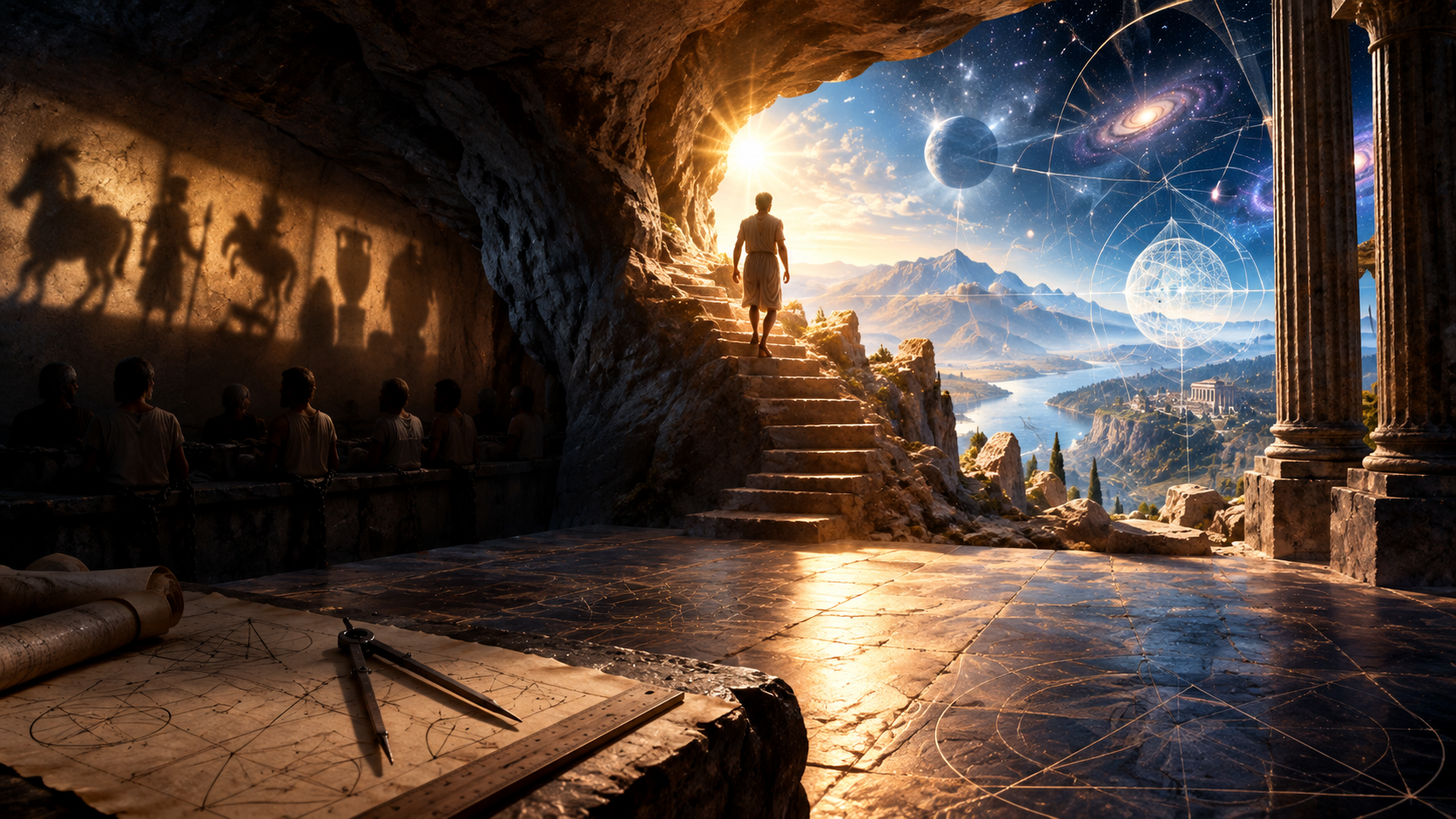
In Book VII of his Republic, Plato describes the famous allegory of the cave.
Imagine people who have lived in a dark cave since birth, chained so that they can look only at the wall in front of them.
A fire burns behind them, and other people pass between the fire and the prisoners, carrying various objects.
The shadows of these objects appear on the cave wall.
But the prisoners have never seen anything else.
For them, these shadows are reality.
Now imagine that one prisoner is freed.
He leaves the cave and, for the first time, sees real objects, sunlight, and the world around him.
Only then does he begin to understand that his entire previous life was limited to observing shadows.
But what happens if he returns to the cave and tries to explain to the others that their understanding of reality is mistaken?
Will they believe him?
Plato describes how the other prisoners may not only refuse to believe him, but also react with hostility to his words.
Plato uses this allegory to demonstrate the difference between what a person perceives through the senses and what they can grasp through reason.
Primary source: Plato—Republic, Book VII, 514a–517a [12].
Now I want to ask you one question: how do we know that we ourselves are not in such a cave?
And if a believer who has managed to leave this cave and see God's power returns and tells an atheist what they have seen, on what grounds does the atheist assume that their own understanding of reality is true and the other person's testimony false?
Science?
But it is scientists themselves, including outstanding physicists and Nobel laureates, who draw attention to the fine-tuning of the Universe, which we examined in the previous chapter.
There is your answer.
Does God Exist?
Unlike the previous two chapters, this chapter offers no evidence for God's existence at all.
Let me recall the conclusions we reached earlier:
- Human consciousness. The very existence of consciousness demonstrates the existence of something immaterial, that is, supernatural and mystical in its essence.
- The fine-tuning of the Universe. This demonstrates something different: a mystical connection between the fundamental laws of nature, their configuration, and the very possibility of life and rational human beings existing.
But in this chapter, I am doing something different and no less important.
Using the axioms of geometry, I demonstrated that not every piece of knowledge requires proof to be considered true or even scientific.
In conversations with atheists, agnostics, and even believers, I often encounter the claim that any knowledge we wish to recognize as reliable or scientific must necessarily be supported by proof.
But the axioms of geometry have shown us that this is not so.
Even mathematics, a model of precision and logical reasoning, rests on starting propositions accepted without proof.
This is precisely where I want to return to theology.
Why can we not apply to theology the same principles of constructing knowledge that are used in other sciences?
If mathematics permits itself axioms describing obvious things, why can we not do the same in theology?
Recall our thought experiment in an earlier chapter, when I asked you to go to a mirror and pay attention to your own consciousness.
I demonstrated that each of us has direct experience of consciousness existing, although we cannot measure it as we measure mass, distance, or temperature.
But is not the very existence of our own consciousness, whose nature is so difficult to explain in material terms, obvious to each of us?
I now want to invite you to formulate the first axiom of theology.
Again, I do so without citing the Bible as an authoritative source, relying exclusively on common sense and what we have already examined.
Thus:
Axiom No. 1. Human consciousness is an example of the existence of the immaterial; that is, it has a supernatural and mystical nature.
Let us return to the definition of an axiom:
“...considered true without proof...”
It is in precisely this sense that I propose accepting this statement as the first axiom of theology.
It allows us to establish a starting proposition on which to build further reasoning about the nature of consciousness, immaterial reality, and God.
And, as with geometric axioms, we do not need to return each time to proving the starting proposition itself in order to investigate its logical consequences.
4. The Second Law of Thermodynamics, Entropy, and Boltzmann's Formula
„Der Alte würfelt nicht.“
“God does not play dice.”
— Albert Einstein [13]
“Einstein, stop telling God what to do!”
— Attributed to Niels Bohr [14]
I began this chapter with two famous statements by Albert Einstein and Niels Bohr in which both distinguished physicists invoke God while discussing the fundamental laws of nature.
Indeed, probability theory can play some intriguing tricks on us, and physics offers many remarkable examples.
Those familiar with the details of the famous debate between Einstein and Bohr know that Einstein's reasoning appeared entirely logical from the standpoint of classical physics and physical determinism. However, subsequent experimental tests of Bell's inequalities ruled out explanations of quantum phenomena based on local hidden variables.
At the same time, the measurement problem and the role of the observer remain among the fundamental unresolved questions of quantum physics.
But now I want to discuss something else: the application of probability theory to natural processes, approached from a different angle.
The second law of thermodynamics is perhaps the most convincing argument for intelligent design that I have been able to find.
This law, along with the related concepts of entropy and Boltzmann's formula, brings together physics, mathematics, and probability theory. Most interestingly, entropy itself has a fundamental connection with information, which is not an ordinary physical quantity but points toward a connection with intelligence and possibly even intelligent design.
Historically, thermodynamics developed largely through attempts to understand and improve the efficiency of heat engines, particularly steam engines.
However, Boltzmann's formula has much broader applications. It is one of the fundamental relations of statistical physics and helps explain an enormous number of natural processes, extending far beyond heat engines.

Understanding the basic idea of the second law of thermodynamics does not require delving into complicated mathematical formulas.
For example, I found a very simple and clear explanation in the English Wikipedia:
For example, the first law allows the process of a cup falling off a table and breaking on the floor, as well as allowing the reverse process of the cup fragments coming back together and 'jumping' back onto the table, while the second law allows the former and denies the latter.
Wikipedia—Second law of thermodynamics [15]
In other words:
The first law of thermodynamics allows a cup to fall off a table and break on the floor, as well as the reverse process, in which its fragments reassemble and “jump” back onto the table. The second law, however, permits the first process but rules out the second.
Personally, I find mathematics extraordinarily interesting as a science. However, I understand that not every reader shares this enthusiasm.
I will therefore first try to show how the second law of thermodynamics relates to the origins of life and God's existence, without requiring specialized knowledge of physics or mathematics.
After that, we can examine Boltzmann's formula and its mathematical meaning in greater detail and try to understand why it is so remarkable.
A Simple Explanation of the Second Law of Thermodynamics
The example of a broken cup is easy to understand. None of us has ever seen the fragments of a broken cup assemble themselves back into a whole cup.
At the same time, according to evolutionary theory, processes took place on Earth over billions of years that led to the emergence and development of extraordinarily complex forms of life.
Here we encounter a paradox that I want to investigate.
Since I eventually want to move from general reflections to specific mathematical formulas, let us first examine how the second law of thermodynamics relates to life.
DNA
I think it is no secret that one of the most complex molecules in our bodies—DNA—is protected by several layers of biological barriers.
Our bodies are protected externally by skin. Each cell is then separated from its surroundings by a cell membrane. Inside human cells, most DNA is contained in the nucleus, which is also surrounded by its own double membrane.
But what happens if we extract this molecule from the cell and simply leave it out in the open air?
It will be exposed to oxygen, water vapor that can participate in hydrolysis reactions, and various forms of radiation, including sunlight.
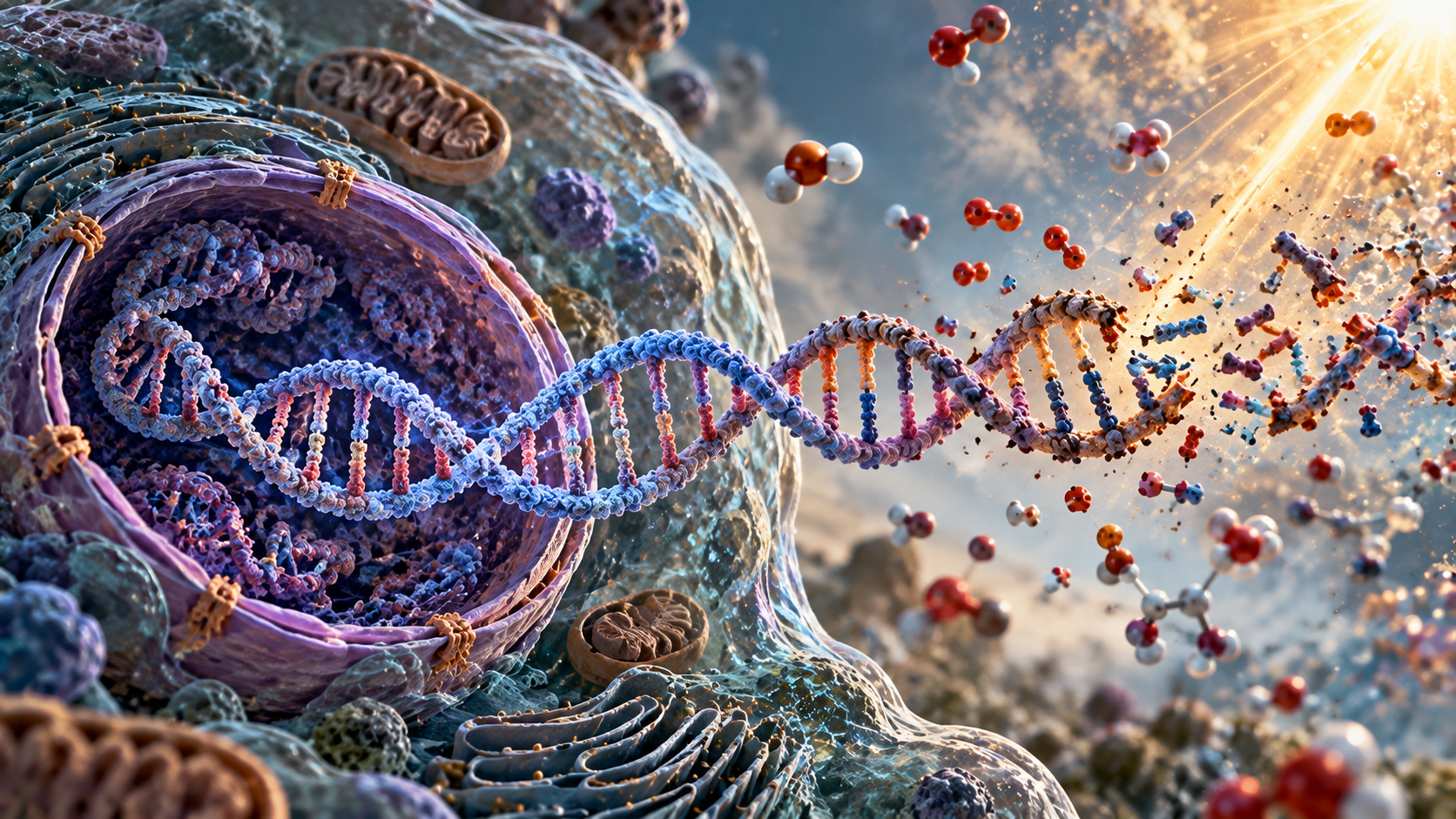
Under such conditions, a DNA molecule may sustain its first damage within hours. Under more favorable conditions, this may take days or considerably longer.
Nevertheless, without appropriate storage conditions, damage will accumulate over time, compromising the integrity of the molecule and the genetic information stored within it.
Eventually, breaks will occur in the sugar-phosphate backbone, causing the molecule to fragment into shorter pieces.
All this is the result of ordinary physical and chemical processes in a nonliving environment, even without bacteria or fungi, which would gladly feast on the molecule if they encountered it.
An Apple
Now let us consider a more complex example: an apple.
An apple is more than an individual molecule or cell. It is a complex biological structure consisting of an enormous number of cells capable of sustaining their life processes and protecting DNA molecules from degradation.
But an apple grows and ripens while it remains attached to the tree.
Pick it and leave it on a table for a while, and sooner or later it will begin to spoil and eventually rot.
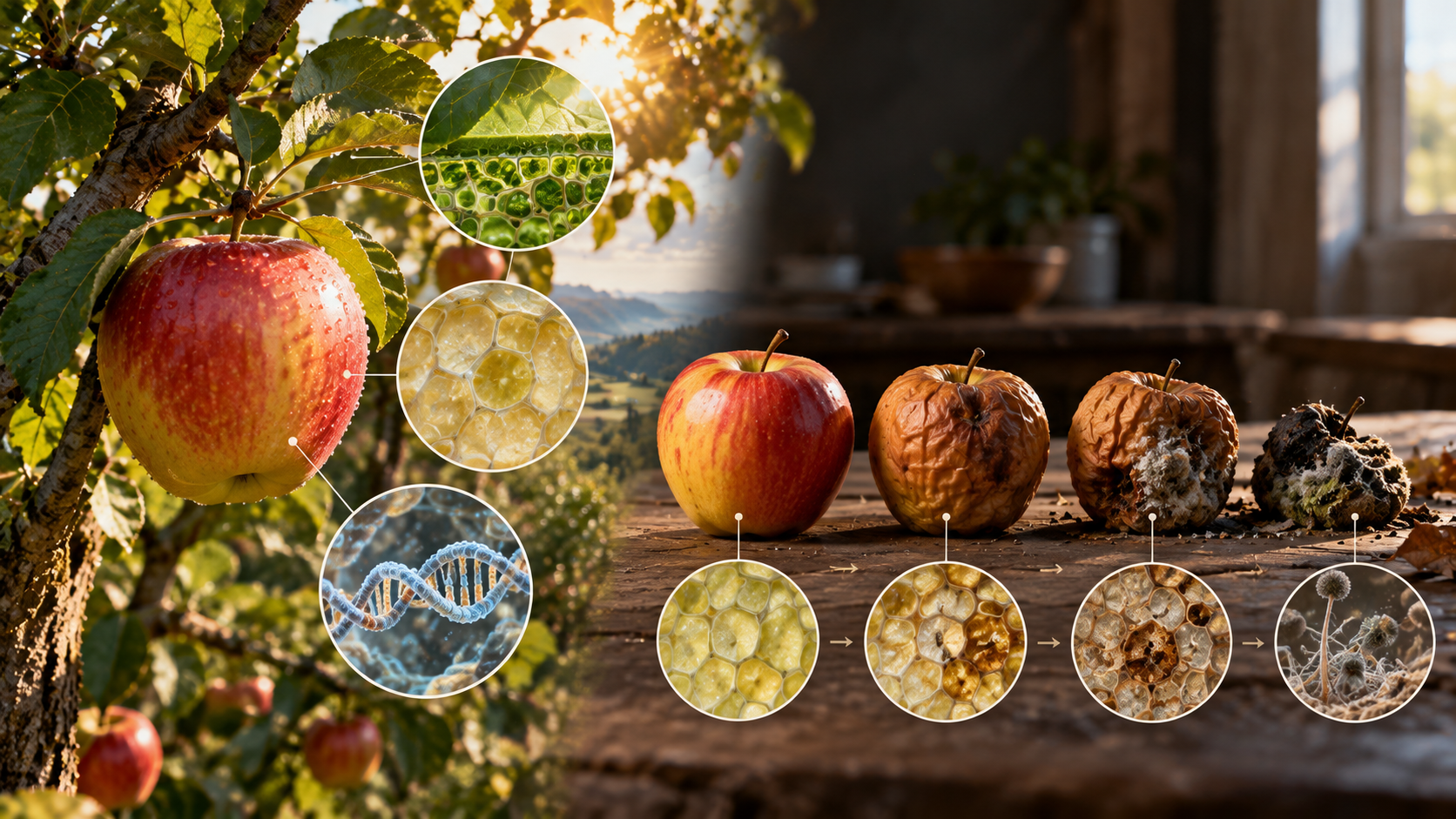
Here we see an important pattern: even a biological structure as complex as an apple is not entirely self-sufficient. For its growth and development, it depends on the tree, which supplies the necessary substances and energy. When this connection is broken, the apple gradually loses its ability to sustain its life processes, and destructive processes ultimately prevail.
A Tree
When we discuss DNA, we see a clear dependence: its preservation requires particular conditions, which may be provided, for example, by the cells of an apple or a leaf.
But if we pick an apple or a leaf from a tree, without that connection it gradually loses the ability to sustain its life processes.
We can ask a similar question about the tree itself.
Can a tree exist completely independently?
In fact, trees are among the longest-lived and most autonomous living organisms known to humans.
They can outlive not only a single person, but many human generations. Some trees have even witnessed the rise and fall of entire human civilizations.
But it would be untrue to say that trees are entirely independent of their surroundings.
Although trees can be relatively undemanding, they require water, sunlight, carbon dioxide, and minerals to sustain their life processes.
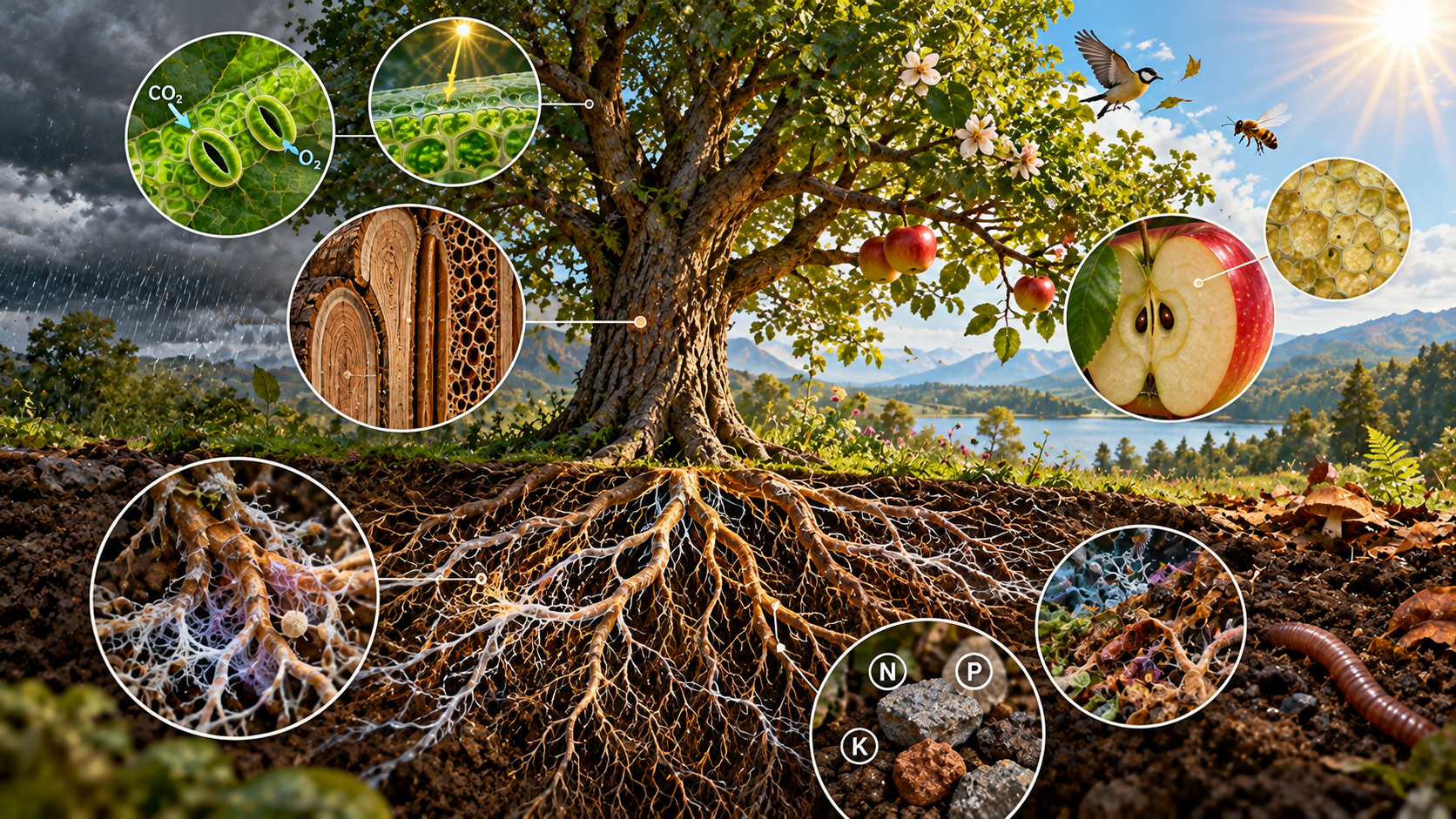
Their existence also depends on an enormous number of other factors. Some promote their growth and development, while others can cause their death.
A natural question arises here.
If particular conditions are necessary to preserve DNA and sustain an apple's life processes, what protects trees and provides them with life-sustaining forces?
If we do not directly see the source of these life-sustaining forces, that does not mean such a source does not exist.
In a broader sense, we can turn to the concept of an ecosystem.
An ecosystem encompasses an enormous number of interconnected living organisms, physical and chemical processes, and environmental conditions on which the viability of trees depends.
For example, some fungi enter into symbiotic relationships with trees, helping them obtain water and nutrients from the soil, while others are pathogenic and can cause disease and even the death of trees.
The Entropy of Life
The examples of DNA and an apple are quite clear.
We can directly observe that preserving their integrity depends on particular conditions that maintain their complex organization.
The situation with trees is somewhat more complex, but we can still turn to the concept of an ecosystem that provides an enormous number of conditions necessary for their existence.
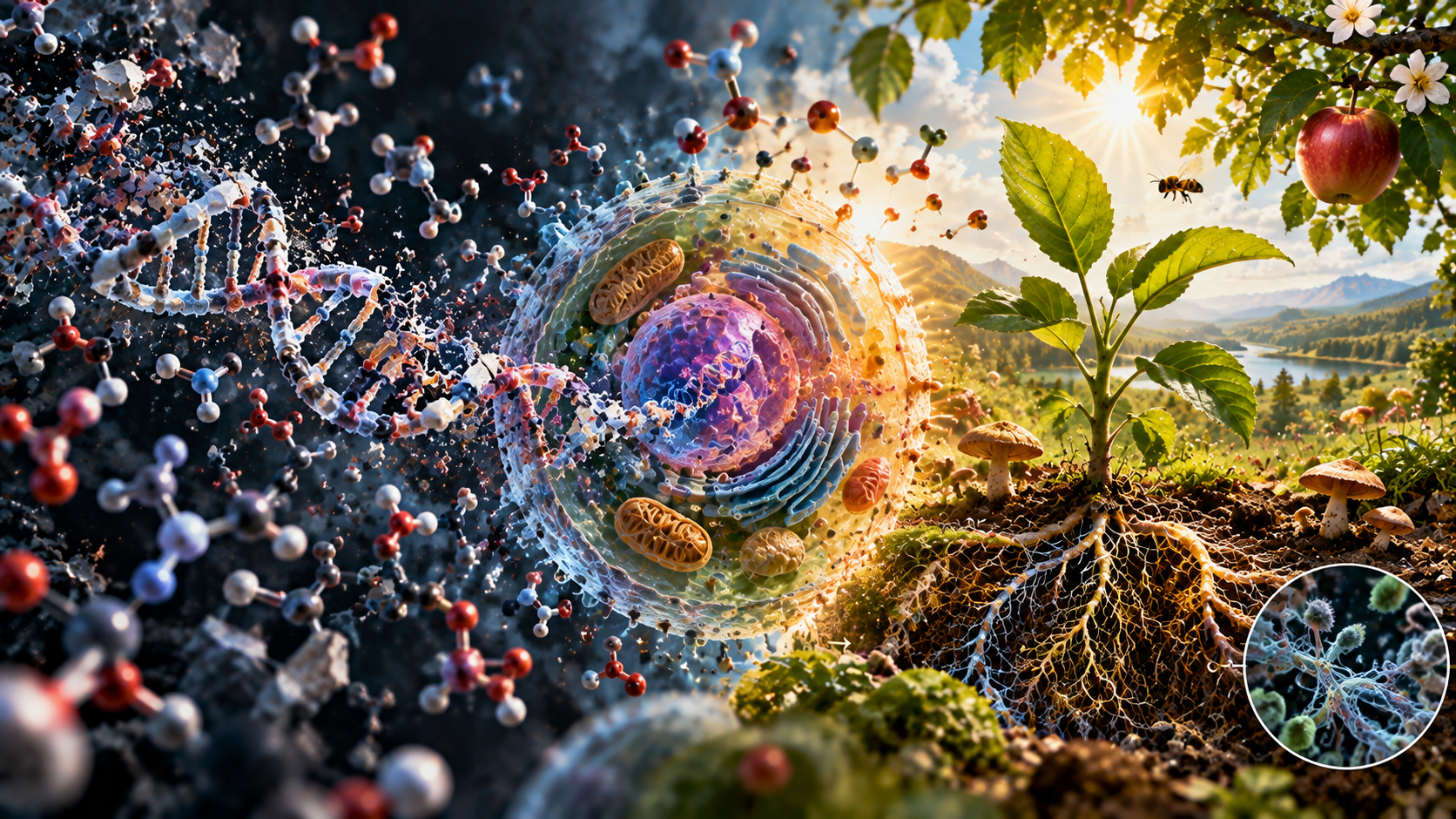
However, another question arises here.
If an ecosystem can provide the life-sustaining forces necessary for trees to exist, where does it obtain those life-sustaining forces itself?
And why does this question arise at all?
If something can sustain another organism's life, what sustains the existence and life processes of that source itself?
This is where I want to turn to the second law of thermodynamics and the associated concept of entropy.
The second law of thermodynamics states that the entropy of an isolated system cannot decrease as a result of macroscopic natural processes.
But what does this mean in practice?
Imagine a room that is an isolated physical system.
Suppose we gather a certain number of atoms and arrange them in an extraordinarily specific configuration, forming a complex DNA molecule.
Now suppose the atoms making up the DNA molecule already have sufficient kinetic energy to break its chemical bonds and scatter in all directions. Alternatively, suppose we heat the molecule until it breaks down completely and its constituent parts scatter throughout the room.
According to Boltzmann's classical statistical definition of entropy, the greater the number of microscopic states corresponding to a particular macroscopic state of a system, the higher its entropy.
Thus, if the constituent parts of the DNA molecule gain many more possible configurations after its breakdown, and the total number of accessible microstates of the system increases, its entropy increases accordingly.
But can these particles reassemble on their own to form the same DNA molecule?
The probability that all the necessary atoms will randomly occupy the right positions and form the appropriate chemical bonds may be so small that we would practically never observe such a process.
It is the statistical nature of the second law of thermodynamics that explains why certain processes occur in one direction, whereas their reverse is extraordinarily improbable.
Here we reach the most interesting part.
When we think about life and evolution as a whole, we observe an extraordinary phenomenon.
Over billions of years, increasingly complex biological structures emerged and developed on Earth.
Molecules combined into complex systems; living cells emerged, followed by multicellular organisms and eventually an enormous diversity of life forms.
All of this occurred in a world governed by the same physical laws that explain why a broken cup does not reassemble itself and an unprotected DNA molecule gradually degrades.
How, then, can natural processes not only destroy complex structures, but also create and sustain them?
For life to exist, merely having energy or the necessary chemical elements is not enough.
An enormous number of interconnected conditions and processes are required to ensure the functioning of complex biological systems.
And if even a single tree depends on so many factors, what ensures the existence and viability of the entire ecosystem?
What is the source of evolution? What allows living systems to maintain their complex organization and resist destructive processes?
And what role does entropy play in all of this?
I will answer these questions—again, without appealing to the Bible as an authority.
But first, let us go a little deeper into the mathematics.
Is Earth an Open or Closed System?
One of the most pertinent counterarguments I have heard is that Earth is not a closed system. It would be wrong of me to overlook this counterargument.
Before examining the question, however, let us clarify what physics means by an open or closed system.
Thermodynamics distinguishes three main types of systems:
- An open system exchanges both energy and matter with its surroundings.
- A closed system can exchange energy with its surroundings, but not matter.
- An isolated system exchanges neither energy nor matter with its surroundings.
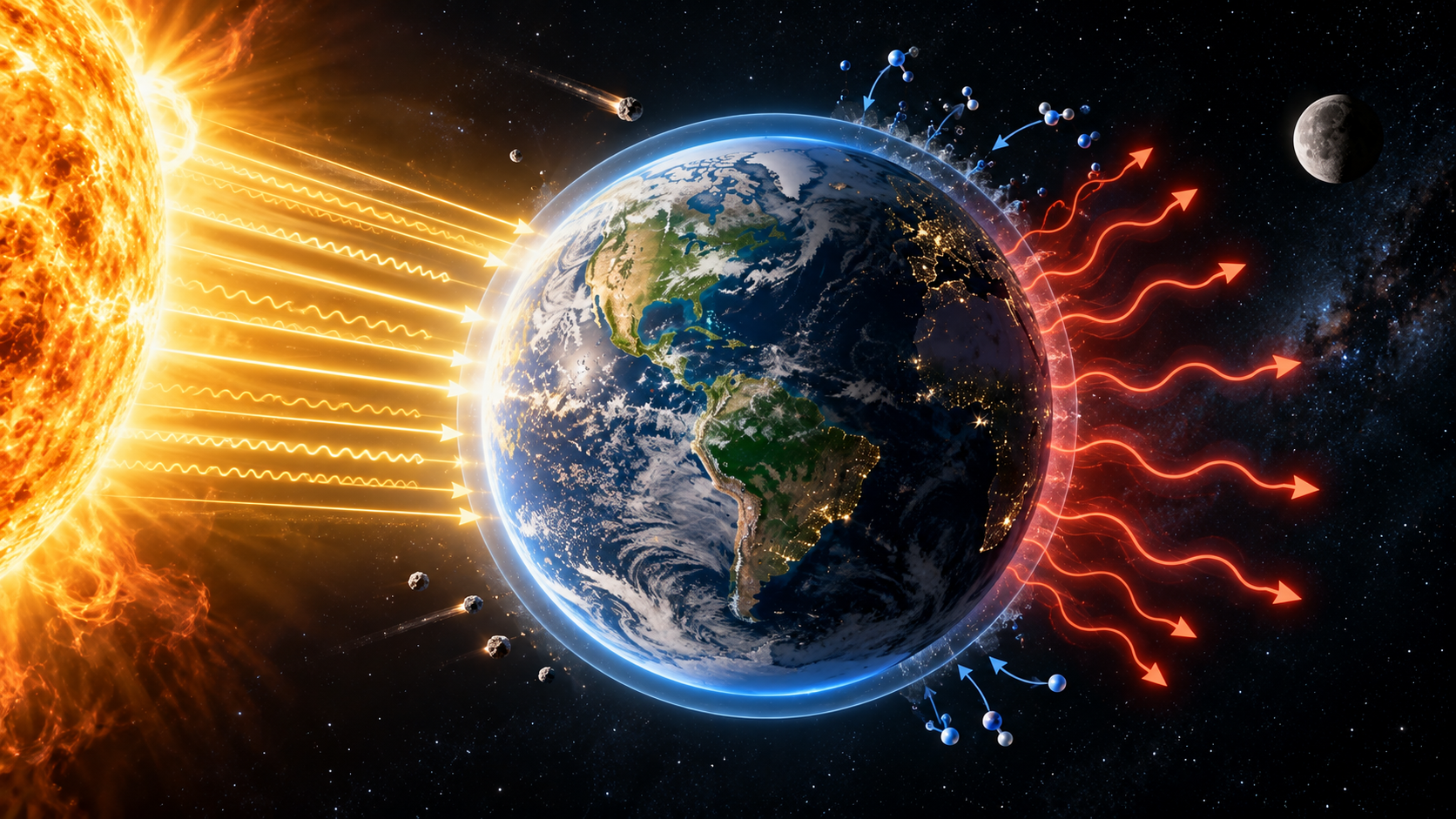
We can already notice something interesting here.
The mere fact that Earth receives energy from the Sun does not mean it is an open system.
A closed system can also receive energy from outside.
Earth is not an isolated system, because it receives an enormous amount of energy from the Sun. Solar energy powers a substantial portion of the physical, chemical, and biological processes on our planet.
At the same time, Earth radiates energy back into space.
The situation with the exchange of matter, however, is quite different.
Of course, meteorites and cosmic dust reach Earth, and some atmospheric gases escape our planet. But this exchange is extraordinarily small compared with Earth's total mass.
Thus, although Earth is not an absolutely closed system, in many physical problems it can reasonably be treated as an effectively closed system that exchanges energy with its surroundings but almost no matter.
The claim that Earth is not a closed system merely because it receives energy from the Sun therefore rests on a misunderstanding of the very concept of a closed system.
Boltzmann's Formula
But does this mean that incoming solar energy is sufficient to explain the emergence and existence of life?
To answer this question, let us return to the second law of thermodynamics.
Interestingly, through entropy, thermodynamics is connected not only with energy but also with information.
There is something almost mystical about the second law of thermodynamics: through entropy, physics establishes a fundamental mathematical connection between energy and information.
To understand what this means, let us examine three formulas.
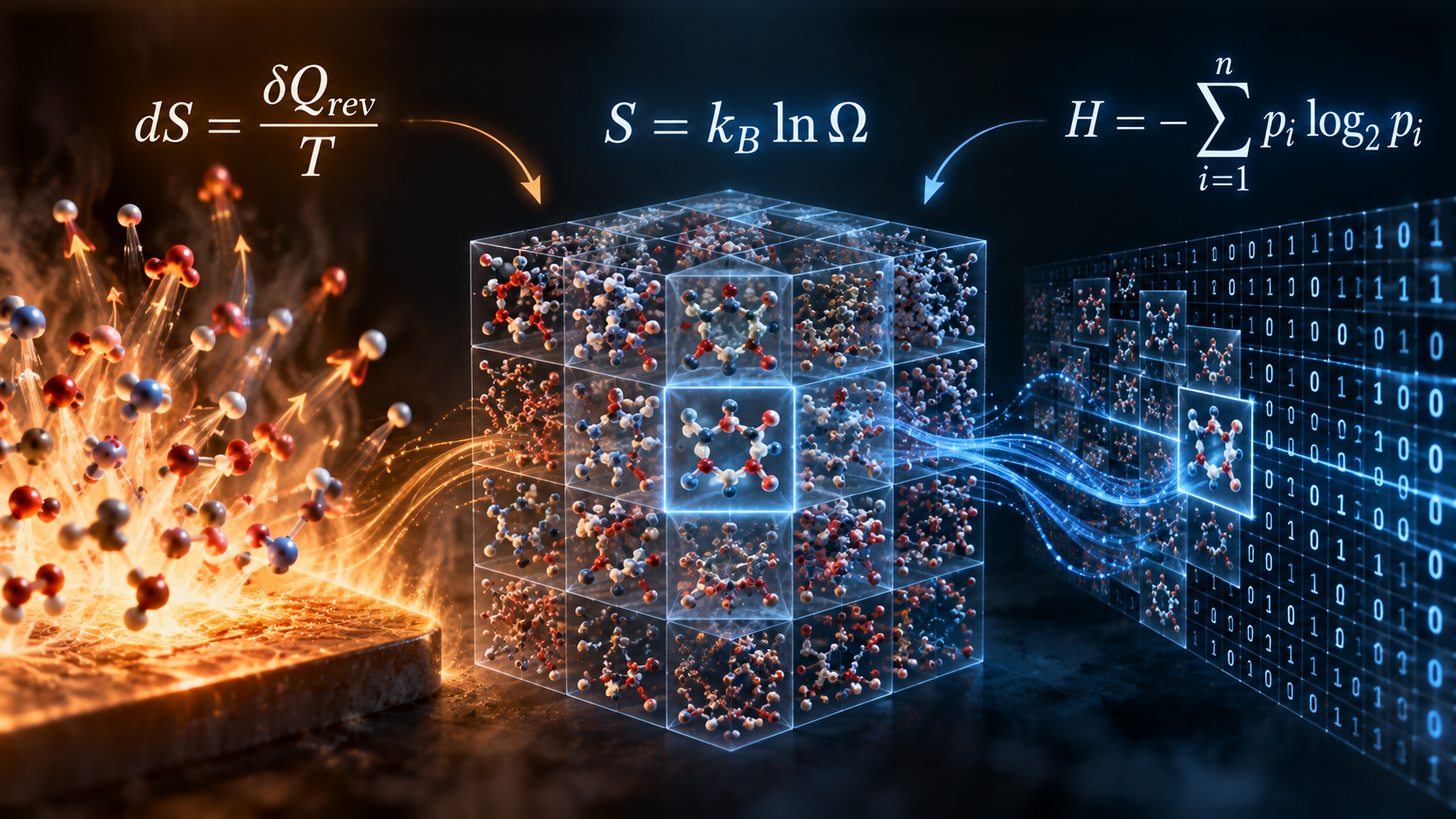
The first is Clausius's formula, describing entropy change through heat transfer during a reversible process:
where
The second is the already familiar Boltzmann's formula:
where
Finally, the third is Shannon's information entropy formula:
where
At first glance, these formulas describe entirely different things.
The first connects entropy with heat, the second with the number of possible microscopic configurations of matter, and the third with informational uncertainty.
But most interestingly, there is a specific mathematical connection between them.
If all possible microscopic states of the system are equally probable, Shannon's formula becomes:
Comparing this with Boltzmann's formula, we obtain:
Thus, under these conditions, thermodynamic entropy is directly proportional to information entropy.
But we can go further and establish a direct connection with energy.
For a reversible isothermal process, Clausius's formula gives:
Substituting the relationship between thermodynamic and information entropy, we obtain:
where
Thus, under specified physical conditions, we can mathematically convert a change in information entropy, measured in bits, into an amount of transferred heat, measured in joules.
This does not mean that any information is itself energy. But the connection demonstrates how closely a system's informational and physical characteristics are related.
The point is that information is not quite an ordinary physical quantity like mass or energy.
In everyday understanding, information is associated with knowledge, intelligence, and mind. This is why this fundamental connection between physics and information brings us back to intelligent design.
Are Energy and Chemical Elements Sufficient for Life?
We can say that Earth itself is an enormous source of various chemical elements and compounds.
But if we take humans as an example, we see how strongly our existence depends on an enormous number of extraordinarily complex organic molecules, many synthesized by living organisms.
The crucial question here is not whether organic compounds can form without life at all, but how complex the particular molecules on which life depends are.
For example, the simplest amino acid, glycine, consists of only ten atoms. We know that simple organic compounds of this kind can form without living organisms.
But compare it with vitamin B12, whose molecule consists of 181 atoms arranged in an extraordinarily complex chemical structure.
The human body cannot synthesize this vitamin on its own. In nature, certain bacteria and archaea synthesize it through complex, multistep biochemical processes.
This is only one of many examples.
Thus, the question is not simply whether Earth contains the necessary chemical elements or even individual organic compounds, but where the complex molecular structures and biochemical mechanisms on which life depends came from.

I did not choose the example of a tree by chance.
I approach my analysis extremely responsibly and critically. That is why I chose the example that, in my view, is the most difficult to explain in terms of a living organism's dependence on external sources of complex organic substances.
Trees are indeed a good example of the interaction between living and nonliving nature.
Plants primarily require water, carbon dioxide, sunlight, and simple minerals, all of which existed on Earth before life emerged.
Unlike a human, a tree can independently synthesize many of the organic compounds it needs from relatively simple substances.
This would seem to answer our question.
But even here, things are not so simple.
First, a tree does not merely receive the Sun's energy. It possesses extraordinarily complex molecular mechanisms that convert this energy into chemical energy and use it to synthesize the necessary substances.
Second, a tree does not exist in a vacuum. Its life depends on an enormous number of physical, chemical, and biological factors, including soil properties, nutrient availability, temperature, water, and interactions with other organisms.
Our failure to see all these interconnections certainly does not mean they do not exist.
But that is not all, because the fine-tuning of the Universe remains an issue.
An atom is far from as simple as it may first appear.
Nuclear processes inside stars produced carbon, a chemical element whose properties make it an extraordinarily reliable foundation for constructing complex organic molecules.
Carbon forms the basis of the molecular structures on which life as we know it is built.
And the question of why a planet exists in the Universe with all the necessary chemical elements and conditions for life does not disappear.
Now let me offer another simple and direct example.
Suppose we take an apple and leave it exposed to intense sunlight, for example in a region with a hot, humid climate.
We have thereby supplied the apple with a large amount of solar energy and even the moisture needed to sustain life.
But does this mean we have prolonged its life?
Not at all.
Moreover, excessive heating, intense sunlight, and excessive humidity may even accelerate damage and decay.
Thus, the mere presence of energy and even the chemical elements necessary for life does not mean they will help sustain life.
This requires appropriate conditions and complex mechanisms that allow living organisms to use energy to sustain their life processes.
The same applies to chemical substances.
Some mineral compounds found in nature in their original form can be toxic to living organisms. Rather than helping preserve life, they may accelerate the destruction of biological structures.
Therefore, the mere presence of solar energy and the necessary chemical elements does not explain the origin of extraordinarily complex living systems.
Here, we return once again to probability.
Merely having the necessary atoms and an energy source is not enough. We must also explain how these atoms form complex molecules, how mechanisms of interaction arise, and how systems capable of maintaining and reproducing their own organization emerge.
The question of how random processes, statistical regularities, and physical conditions can give rise to such complex and interdependent systems does not disappear.
On the contrary, the more we investigate the complexity of living systems, the more questions arise about the mechanisms of their origin.
And the more complex such a system becomes, the lower the probability of its arising by chance.
Thus, the counterargument that Earth receives energy from the Sun does not resolve the question of life's origin. It explains the presence of an energy source but leaves open the origin of the mechanisms that allow living organisms to use that energy.
Entropy and Consciousness
I hope the nature of the paradox between our biological knowledge of evolution and the laws of physics, particularly the second law of thermodynamics, is now clear.
Personally, I find the paleontological evidence for evolution entirely sufficient. In addition, the stages of human embryonic development clearly demonstrate our evolutionary relationship with distant ancestors. We have, after all, inherited genetic information from countless generations of our forebears.
Therefore, for me, evolution is an established scientific fact, not merely a conjecture.
At the same time, I understand very well the reasoning associated with the second law of thermodynamics: complex ordered structures do not arise by themselves out of nothing. For me, this is also a fact.
I have no intention of refuting either of these scientific propositions.
When I first encountered this contradiction, I considered one simple question.
Have I ever seen examples in my own life of complex things spontaneously beginning to organize themselves without any visible first cause?
Strangely enough, I found something interesting.
Look carefully at this picture.

I cannot say with certainty that the blocks in this picture assembled themselves into a tower. But something here is entirely obvious.
-
First, this structure is ordered. The number of possible configurations in which the blocks form this particular tower is much smaller than the number in which they can be scattered arbitrarily across the floor. Thus, considering only the spatial arrangement of the blocks, the tower corresponds to fewer accessible configurations—that is, lower configurational entropy.
-
Second, the child creates this structure without any obvious practical necessity. The child is not trying to build a house, make a useful tool, or solve some problem essential to survival. The child is simply playing, building a tower because they want to build one.
This prompted some interesting reflections.
Before us is not merely a living creature. Before us is a small human being discovering the world, learning to interact with it, and, most importantly, possessing human consciousness.
One thing we can observe even in early childhood is the desire to organize surrounding objects into new, more complex structures.
If you read the earlier chapter on human consciousness carefully, you may remember one of the questions I asked:
What function does consciousness perform?
And here, it seems, is an excellent example of what it can do.
Consciousness gives us the desire to create order, to organize the world around us into complex structures, and the ability to turn these desires into reality.
Axiom No. 2. Human consciousness can purposefully control physical processes, directing them:
- against the natural tendency toward increasing entropy,
- described by the second law of thermodynamics,
- restoring and creating order and resisting the destruction of complex material structures.
Or, more simply, remember the Wikipedia example in which a cup falls, breaks into fragments, and can no longer reassemble itself?
Well, a person can take those fragments and glue them together, restoring the broken cup. And this is paradoxical from the standpoint of the second law of thermodynamics.
The Bible says: “What is impossible with man is possible with God” (Luke 18:27). Paraphrasing these words for our example, we can say: “What is impossible for a cup is possible for a human.”
Let us consider another example.
Take artificial intelligence.
Modern AI can seem extraordinarily intelligent. We can even imagine an artificial intelligence system capable of self-replication, self-diagnosis, and self-repair.
It is entirely possible that, in its early stages, such a system would even demonstrate exponential growth in the number of its copies.
However, I am convinced that errors would inevitably arise with each successive cycle of self-replication in such a system. These errors would gradually accumulate until the system ultimately lost its ability to function properly. The only reliable way to remedy the situation would be intervention by the system's creator, who would make the necessary changes.
But life shows us something remarkable.
Living organisms do more than reproduce themselves. They can maintain their complex organization, repair damage, pass hereditary information to subsequent generations, and even produce new, more complex forms of life through evolution.
Here, I want to return to the second law of thermodynamics.
In my view, one of the most interesting examples of a local decrease in entropy can be observed in human actions.
I am not talking about the first law of thermodynamics—the conservation of energy. I am referring specifically to the second law, which determines the direction of natural processes and is associated with increasing entropy.
Let us consider a simple example.
Imagine a room with grain scattered evenly across the floor.
This somewhat resembles the classical example of an ideal gas whose molecules eventually fill the entire available volume uniformly.
Now imagine that we let a person into this room.
The person begins doing something extraordinarily interesting.
Grain by grain, they gradually move all of it into one half of the room, leaving the other half completely empty.
From the standpoint of statistical physics, we have just observed a transition from a more probable state to a much less probable one. That is, movement against the natural tendency toward increasing entropy described by the second law of thermodynamics.
Most interestingly, such behavior is entirely ordinary for a human being.
Children do things like this every day. Simply while playing.
Does God Exist?
At the very least, intelligent design exists within human beings themselves, and therefore it exists in the Universe.
The author of this treatise
Why do I consider this argument so strong?
Every day, we observe people creating things. We build houses, manufacture complex mechanisms, develop new technologies, and create works of art. All of this seems so familiar that we do not even consider how extraordinary our very ability to create is.
At the very least, intelligent design exists within human beings themselves, and therefore it exists in the Universe.
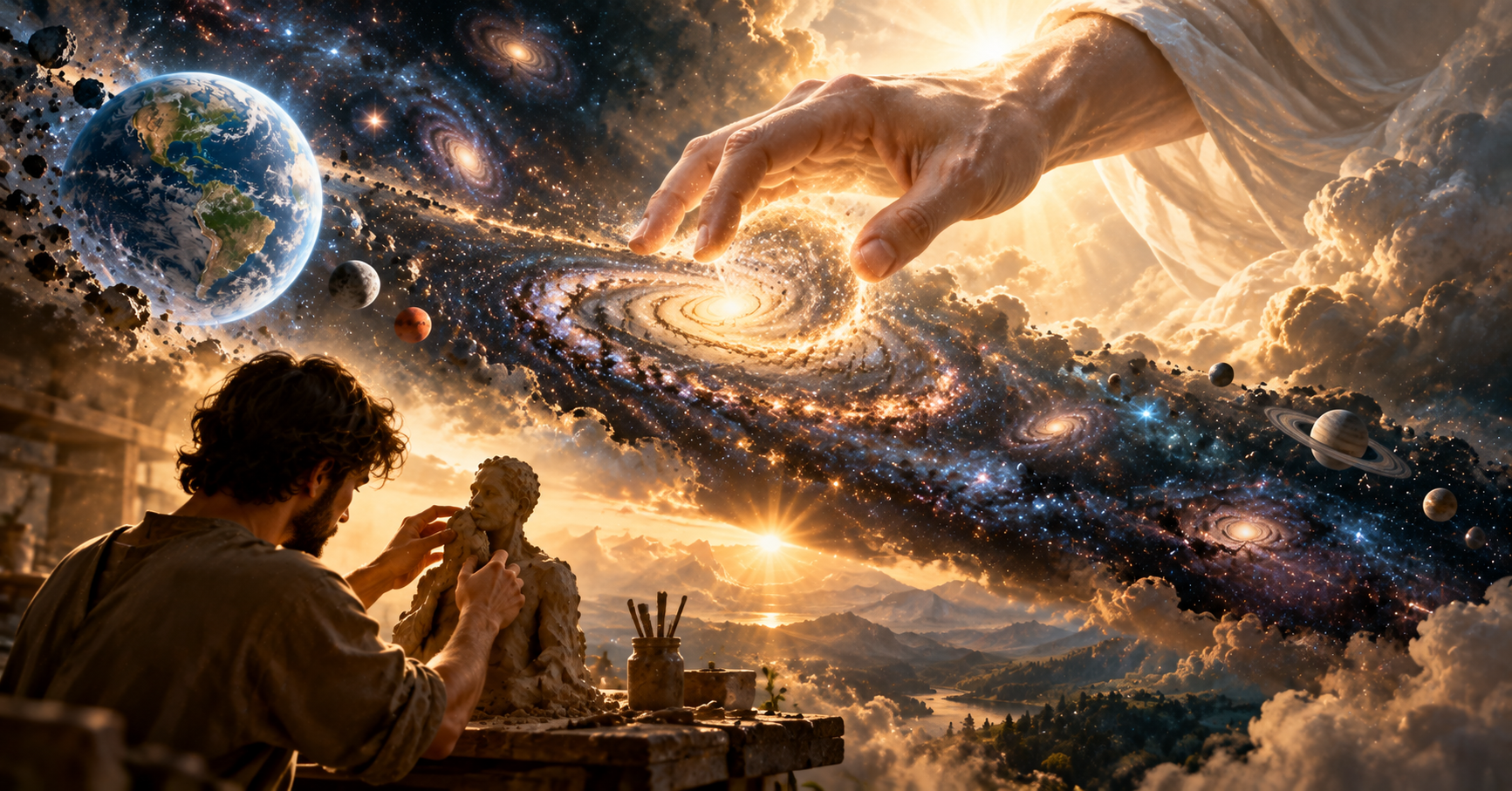
But what is truly extraordinary is that life and complex biological systems emerged long before the first intelligent human appeared.
In earlier chapters, I proposed accepting one fundamental axiom of theology: human consciousness is a manifestation of the immaterial, supernatural, and mystical part of our reality.
Now I want to ask you one simple question.
If humans did not yet exist, where was consciousness?
If we accept our previous axiom, according to which consciousness cannot be exclusively the result of material processes, the absence of material factors does not in itself rule out the possibility of its immaterial, supernatural component existing.
A perfectly natural supposition then arises: something resembling human consciousness must have existed long before the first human appeared—just as time existed long before you hung a clock on the wall.
Moreover, it is entirely logical to suppose that this consciousness, existing independently of humans, manifested itself in some way in the emergence and evolution of life.
This supposition echoes the biblical understanding of God as Creator, as well as the questions we examined in the chapter on the anthropic principle and the fine-tuning of the Universe.
Not to mention that the Bible explicitly speaks of humans being created in God's image and likeness (Genesis 1:26–27).
However, I want to emphasize once again: I am not yet treating the Bible as an argument for God's existence, although the biblical idea itself is extraordinarily interesting, especially in the context of our earlier reflections on our consciousness as our human creative power, and on God's creative power.
Here, I want to return to the small child building a tower of blocks.
Why was the child doing it?
Not for survival. Not for some grand purpose. The child simply enjoyed the act of creation itself.
And you know, the Bible offers an extraordinarily beautiful answer to why God created this world.
God is love.
But let us return to this chapter's central question: does God exist?
Why do I consider the arguments presented here evidence in favor of His existence?
What other mechanism, independent of the material world, could organize matter against the natural tendency toward increasing entropy described by the second law of thermodynamics, just as a person creates order in our example with the grains, and a small child builds a tower of blocks?
I know of no other.
Do you?
If not, then God and we, created in His image and likeness, remain the only logical answer to this question.
We can continue debating at length what exactly God is, what His nature is, and how He interacts with the material world.
But that is an entirely different question.
5. My Gratitude to God
Carl Gustav Jung
“I don't need to believe. I know.”
— Carl Gustav Jung [16]
I like to imagine how this being, possessing consciousness long before humans appeared, arranged atoms as a small child arranges blocks.
Atom by atom, molecule by molecule, creating ever more complex structures.
Until one day these atoms formed something so remarkable that it began to run, leap through trees, explore the surrounding world, and eventually even reflect on its own existence.
And you know, I find this beautiful.
When I think about it, I feel a certain kinship with God.
After all, I also love building with blocks.

And perhaps this simple, childlike joy of creation contains something much deeper than we are accustomed to thinking.
I need nothing more than to feel gratitude for this world He has created.
And whatever time I am granted on this sinful Earth, I will never cease to marvel at and admire the beauty He has created.
I have nothing but boundless gratitude and admiration for the work He continues to do for me, for us, and for all living things.
Sources and Notes
-
René Descartes. Discourse on the Method (1637), Part IV. French original: “Je pense, donc je suis.” Text from Victor Cousin's edition (1824).
-
René Descartes. Principles of Philosophy (1644), Part I, § 7. Latin original: “Ego cogito, ergo sum.”
-
Carl Friedrich von Weizsäcker. Die Geschichte der Natur: Zwölf Vorlesungen (1948). Published by S. Hirzel. German original: “Nach einem alten Satz trennt uns der erste Schluck aus dem Becher der Erkenntnis von Gott, aber auf dem Grunde des Bechers wartet Gott auf den, der ihn sucht.” The author describes this statement as an old saying.
-
Carter, B. (1974). “Large Number Coincidences and the Anthropic Principle in Cosmology.” In: Confrontation of Cosmological Theories with Observational Data, pp. 291–298. The primary source for the formulations of the weak and strong anthropic principles.
-
Weinberg, S. (1987). “Anthropic Bound on the Cosmological Constant.” Physical Review Letters, 59, 2607–2610.
-
Rees, M. (1999). Just Six Numbers: The Deep Forces That Shape the Universe.
-
Barnes, L. A. (2012). “The Fine-Tuning of the Universe for Intelligent Life.” Publications of the Astronomical Society of Australia.
-
Albert Einstein. Letter to Max Born, December 4, 1926. Published in The Born–Einstein Letters (1971), p. 91. German original: “Jedenfalls bin ich überzeugt, daß der Alte nicht würfelt.” English translation: “In any case, I am convinced that the Old One does not play dice.” The statement is widely known in the shortened form: “God does not play dice.”
-
Niels Bohr. “Discussion with Einstein on Epistemological Problems in Atomic Physics” (1949). Published in Albert Einstein: Philosopher–Scientist, edited by Paul Arthur Schilpp, p. 211. Bohr is credited with replying to Einstein: “Einstein, stop telling God what to do!” The exact wording of the quotation is not documented. In his account, Bohr recalls cautioning Einstein against attributing human qualities to Providence.
-
Carl Gustav Jung. Face to Face (BBC, 1959). Interview with John Freeman. English original: “I don't need to believe. I know.” Jung's answer to a question about belief in God.